
A charming Hudson Valley home can check every lifestyle box – mountain views, acreage, a wraparound porch, and room to breathe – while raising one practical question that deserves just as much attention as the roof or foundation: where does the water come from? The private well versus municipal water decision affects daily convenience, operating costs, inspection strategy, and future resale. Neither option is automatically better. The right fit depends on the property, its condition, and how much responsibility you want to take on as an owner.
For buyers moving from New York City or a larger suburb, a private well may be unfamiliar. In many parts of Ulster, Dutchess, Orange, Greene, and Madison counties, it is simply part of country living. Meanwhile, homes in villages, denser hamlets, and established neighborhoods may connect to a municipal or community water system. Knowing how each works helps you evaluate a home with clear expectations before you make an offer.
Private Well Versus Municipal Water: The Core Difference
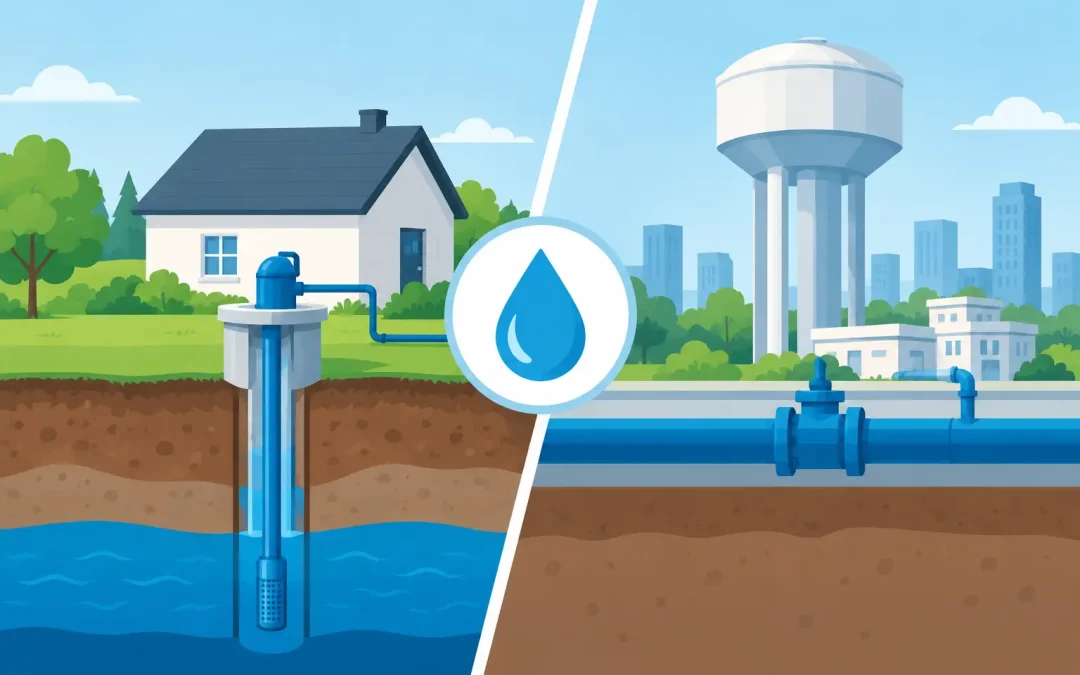
A private well draws groundwater from beneath the property. The homeowner owns and maintains the well, pump, pressure tank, treatment equipment, and usually the line running to the house. Water quality and quantity can vary by location, weather, well depth, nearby land uses, and the condition of the system.
Municipal water is supplied by a public water system. A utility or municipality treats, tests, and distributes the water to connected properties. Homeowners pay a water bill or, in some communities, a combined water and sewer charge. The provider manages the source, treatment process, and main infrastructure, although the homeowner may still be responsible for the service line on private property.
The distinction is less about whether one source is “good” and more about where responsibility sits. Municipal water shifts much of the oversight to the provider. A well gives the owner greater control, along with greater responsibility.
Living With a Private Well
A well can be an excellent feature, particularly for buyers seeking acreage, privacy, or a home outside a village center. There is no monthly water bill based on consumption, and many homeowners appreciate having direct access to their own water source. A properly constructed, productive well can serve a household reliably for decades.
That said, a well is a mechanical system and a water source, not a set-it-and-forget-it amenity. The pump, electrical components, pressure tank, well cap, and any filtration or softening equipment all need attention over time. If a pump fails, the homeowner arranges and pays for the repair. If the water develops an odor, staining, sediment, or an unusual taste, testing is the first step toward identifying the cause.
Water quality is property-specific
Two homes a mile apart can have very different well water. In the Hudson Valley, buyers may encounter naturally occurring minerals, hardness, iron, manganese, sulfur odors, low pH, or other conditions that require treatment. None of these automatically makes a home a poor choice. The key is understanding the test results, the equipment already installed, its age and service history, and whether the treatment solution is appropriate.
A standard real estate water test may not answer every question a buyer has. Depending on the property and local conditions, a buyer may want to discuss expanded testing with a qualified laboratory or water professional. Common testing categories include bacteria, nitrates and nitrites, lead, arsenic, mineral content, and other contaminants relevant to the area. Your inspection and financing requirements can also influence the scope and timing of testing.
Water quantity matters, too
Quality gets most of the attention, but yield is equally important. A household needs enough water for showers, laundry, dishwashing, guests, irrigation, and possibly a pool or livestock. Ask the seller for available well records, including the well depth, yield when drilled, pump replacement dates, treatment invoices, and any past low-water events.
A well that has supplied a family comfortably may still merit closer review if your planned use is different. A weekend cabin with two occupants has different demands than a full-time home for five people, frequent guests, and extensive landscaping. During a home inspection, a qualified inspector can help assess visible components and water flow, but buyers should understand the limits of a single visit. Seasonal conditions and long-term groundwater patterns do not always reveal themselves in one afternoon.
What Municipal Water Offers
Municipal water appeals to many buyers because it is predictable from an ownership standpoint. Public water systems are subject to regulatory monitoring and treatment requirements, and customers generally receive regular reporting about their water supply. If there is a water-quality concern in the system, the provider is responsible for communicating with customers and taking corrective action.
For a buyer who wants fewer property systems to manage, that can be reassuring. You turn on the tap, pay the bill, and call the water provider if there is a service issue affecting the public system. There is typically no private pump to maintain, no pressure tank to replace, and no need to arrange routine testing of the source water yourself.
The trade-off is ongoing cost and less individual control. Water rates, minimum charges, and connection fees vary substantially by municipality. Some homes have water meters, while others are billed at a set rate. In certain areas, municipal water is paired with municipal sewer, which can simplify wastewater management but adds another utility cost.
Public water can also have its own characteristics. Treatment methods, mineral content, chlorine taste, and aging local infrastructure may influence how water looks or tastes at the tap. Some homeowners choose point-of-use filters for drinking water, whether they have public water or a private well. A municipal connection reduces some responsibilities, but it does not eliminate the value of reviewing the property’s plumbing and water service line during due diligence.
Cost: Look Beyond the Monthly Bill
It is easy to assume a well is always cheaper because there is no water bill. Over the long term, that is not necessarily true. Well owners should budget for periodic testing, treatment-system maintenance, filter or salt replacement where applicable, and eventual repairs to pumps or tanks. A major repair can be an unexpected expense, especially if the system is older.
Municipal water creates a recurring expense that is easier to forecast. The bill may be higher in some communities than buyers expect, particularly when sewer charges are included. But the utility bears the cost of operating treatment facilities, maintaining water mains, and managing broad system issues.
When comparing two homes, ask for actual utility bills rather than relying on assumptions. For a well property, request records for equipment servicing and ask what the current owner spends on filters, salt, UV treatment, or other maintenance. For public water, confirm the current billing structure and whether there are any known assessments, connection issues, or service-line concerns.
How Water Source Affects a Real Estate Transaction
Water should be part of the early conversation, not a detail saved for the final walkthrough. Before submitting an offer, confirm whether the property uses a private well, municipal water, or a community system operated by a homeowners association or private provider. Also verify whether the home is connected to public sewer or relies on a septic system. These are separate systems, and a home may have one public service and one private service.
For a well, buyers commonly include appropriate inspection and water-testing protections in their due diligence plan. The exact approach should reflect the home, the market, lender requirements, and local practices. Some loan programs may require specific water testing or well-distance standards. In a competitive situation, a knowledgeable agent can help you understand how to protect your interests without writing an unnecessarily vague or unworkable offer.
For municipal water, review seller disclosures, utility information, and the condition of the visible plumbing. If the property is older, ask whether the water service line has been replaced and whether there have been leaks, low pressure, or recurring plumbing concerns. Public water entering the property does not guarantee that every pipe inside the house is new.
Which Option Fits Your Home Search?
Municipal water may be the stronger fit if convenience, predictable maintenance, and a lower level of hands-on responsibility are priorities. It is often attractive to first-time buyers, buyers with limited time for property upkeep, and anyone purchasing a home in a village or neighborhood where public services are readily available.
A private well may be an excellent fit if your search is centered on rural settings, larger parcels, or homes where independence and privacy are part of the appeal. It can be especially rewarding when the well has strong records, satisfactory water quality, adequate yield, and properly maintained treatment equipment.
The best decision comes from evaluating the specific property rather than treating the water source as a shortcut to yes or no. A well-maintained private system can be a major asset. A municipal connection can be a practical advantage. Either deserves the same careful review you would give to the roof, heating system, and septic or sewer arrangement.
When you find a Hudson Valley home that feels like your next castle, let the water source become a well-informed detail of the decision, not a last-minute surprise. Windsor Realty Services can help buyers ask the right property-specific questions early, so the home you choose supports both the lifestyle you want and the ownership experience you expect.
Recent Comments